How AI-powered call analysis improved vulnerability recognition by 19 percentage points, achieved 93% operator agreement with AI assessments, and gave operators "a safety net to make the right decision" across all emergency and non-emergency call types.
Performance metrics independently validated through operational deployment in Humberside Police's Force Control Room.
Repeat Victim ID
58% → 77% improvementOperator Agreement
With AI assessmentsQualifier Accuracy
Auto-identified correctCopy-Paste Adoption
Active workflow integrationAn independent evaluation conducted by the University of Sussex assessed Untrite's impact through a multi-week randomised control trial covering both 999 and 101 calls. The evaluation combined quantitative metrics with qualitative operator interviews.
Improved vulnerability recognition — Identification of repeat victims increased substantially from 58% to 77% (+19 percentage points), and correct identification of persons involved rose from 74% to 81%. Given that vulnerability recognition is a core design objective, these improvements represent a meaningful positive finding.
High operator agreement — Automatically identified qualifiers were judged correct in approximately 89% of responses, and operators agreed with Untrite's overall assessments in 93% of cases, indicating strong alignment between AI recommendations and professional judgement.
Active integration — Copy-and-paste use of Untrite content occurred in nearly half of completed surveys, suggesting active integration into call records. Disagreement with outputs was uncommon and typically reflected contextual nuances rather than outright rejection.
Strong post-call value — All seven participants reported post-call benefits, particularly in structured summaries, standardised SPA text, and the ability to validate or recover missed details. Operators commonly returned to Untrite post-call for documentation uplift.
"I actually don't want it to go" — Several operators expressed strong personal support for the tool. One noted: "It's probably improved my questioning skills." Another described Untrite as "a safety net" which reduced stress and enabled higher quality service.
Efficiency gains — Operators who engaged deeply with the system achieved significant improvements. One nearly doubled their call volume while reducing average handling time by 15.6% and improving quality scores — demonstrating that Untrite can coexist with significantly higher throughput.
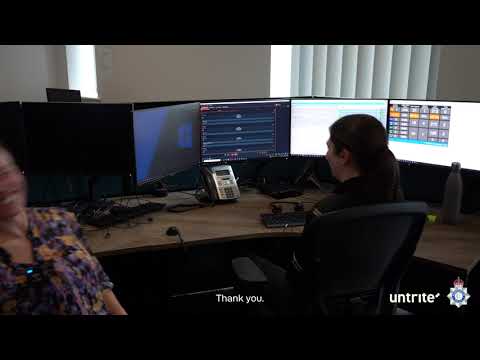
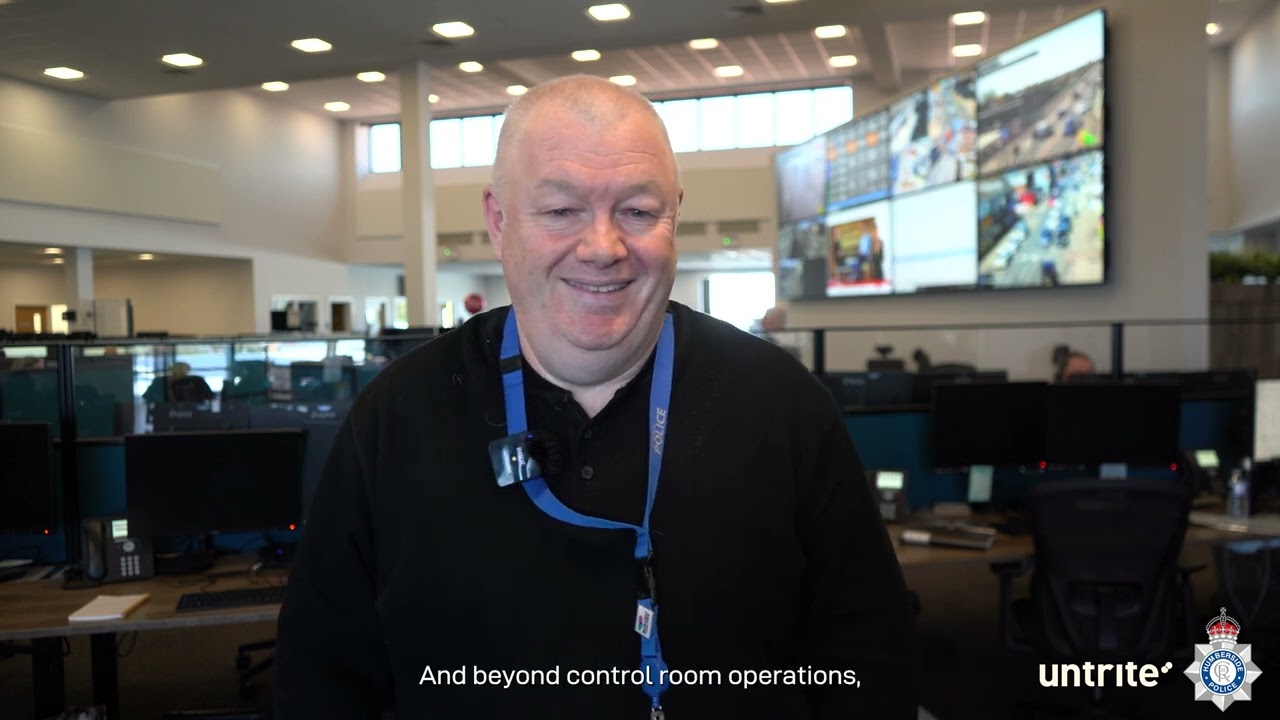
See how THRIVE operates in a live Force Control Room environment.
The framework used by UK police forces to assess the right initial response to a call. Our AI automates this assessment in real-time, placing the victim at the centre of every decision.
Immediate danger assessment and threat level indicators
Physical, psychological, and financial harm evaluation
Likelihood of escalation and repeat offending
Evidence requirements and investigative opportunities
Victim vulnerability factors and safeguarding needs
Appropriate response and resource deployment
Humberside Police's Force Control Room handles thousands of emergency and non-emergency calls every day. From domestic incidents to missing persons, mental health crises to anti-social behaviour — each call requires rapid assessment and careful documentation.
Call handlers faced an overwhelming task: extract critical information from distressed callers, conduct background checks, make rapid THRIVE assessments, and populate multiple backend systems — all while maintaining composure and providing support to the caller.
This challenge exists within a broader crisis: UK police forces spent approximately £2 billion on IT in 2024-25, with 97% allocated to maintaining legacy systems. According to NPCC Review 2024, forces lose 443,000 officer hours annually on unnecessary admin. 56% of officers spend 3+ hours per shift on documentation alone. The retention crisis is acute — 43% of officers leaving have less than 5 years service, with administrative burden cited as a key driver.
Working with the Police Digital Service and NPCC's Digital Public Contact programme, we deployed THRIVE directly into Humberside's Force Control Room. The system was trained on two years of historic call data provided by Humberside — and critically, we retrained our models for northern accents to achieve optimal accuracy across all call types.
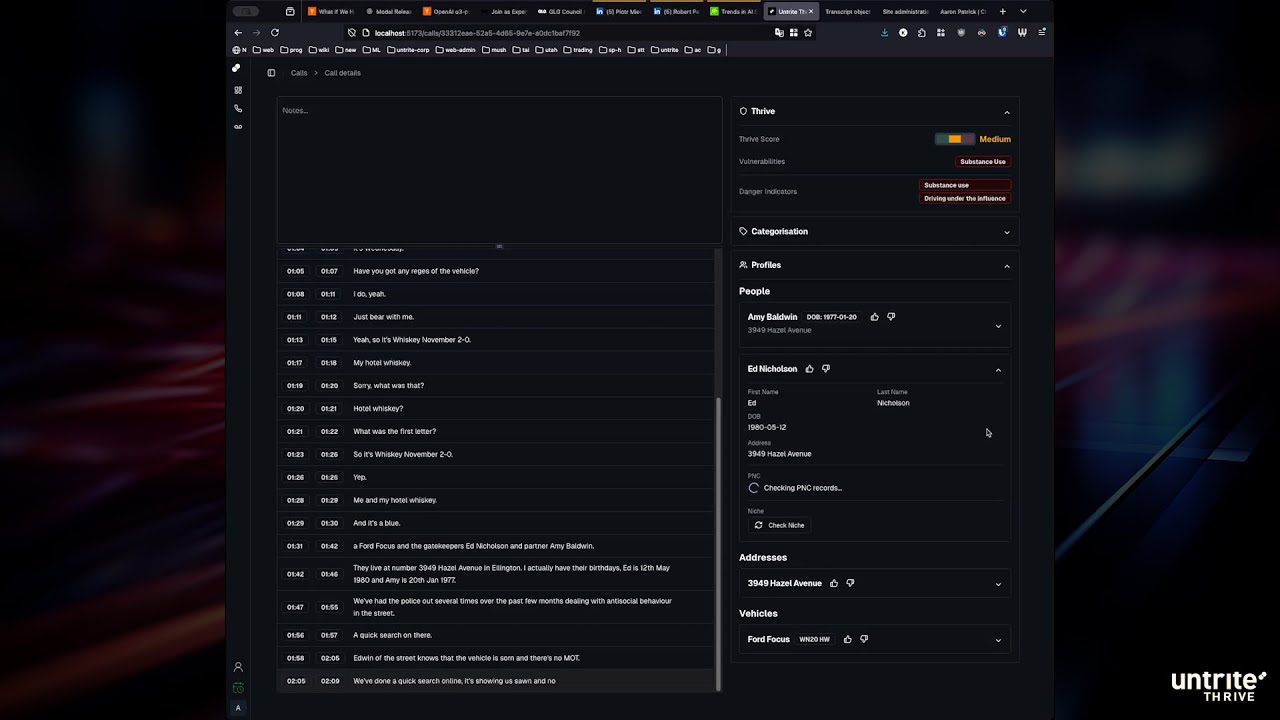
The AI listens to live calls, transcribes speech in real-time, and uses advanced natural language processing to understand context — not just keywords. It identifies relevant information and "danger words," surfaces historical data, and automatically suggests a THRIVE risk score for the operator to review.
The system acts as a personal assistant to call handlers: recording important information, carrying out background searches, and equipping operators to better support callers while maintaining complete human oversight.
"The call operators called the AI assistant a safety net to make the right decision."— Humberside Police FCR Evaluation
The deployment covered both 101 non-emergency and 999 emergency calls across the full spectrum of incident types handled by the Force Control Room. The collaboration was funded by Humberside Police, the Office of Policing Chief Scientific Adviser, and other policing partners.
A measured approach allowed us to validate accuracy, refine the accent models, and build operator confidence — before expanding to full operational coverage. The system now supports multi-operator deployments across shifts.
"We are immensely proud of the strides we have made in integrating AI into our emergency response systems. This project not only showcases our commitment to innovation but also our dedication to providing the best possible service to the public."— Scott Dunn, Head of IT, Humberside and South Yorkshire Police
The scale of national demand. Our deployment covered all call types — emergency and non-emergency — with capability to scale across all forces.
From domestic incidents to missing persons, mental health crises to anti-social behaviour — THRIVE supports the full spectrum of FCR demand.
Deployed across shifts in a live Force Control Room environment, supporting operators around the clock.
Humberside's forward-looking approach led them to partner with us. According to HMICFRS, they're the most improved and best performing force in England and Wales.
The successful deployment at Humberside demonstrated that AI can increase both officer and public safety, improve evidence collection, and reduce staff stress across all call types.
We're currently in discussions with several police forces and other emergency services to deploy THRIVE in live environments nationally.
See how Untrite can reduce handling time, improve consistency, and give your operators a safety net to make the right decisions.